
BOPSS Evening Webinar
Thursday 23rd October 2025
The British Oculoplastic Surgery Society (BOPSS) presents our educational webinar, on Comprehensive Lacrimal Management, featuring an expert faculty.
“From Probe to Pathology: A Complete Guide to Lacrimal Surgery”
BOPSS Evening Webinar: Thursday 23rd October 2025 Time: 7:00 PM – 9:00 PM GMT
This session provided a critical overview of the diagnostic and surgical approaches to the lacrimal system, from basic anatomy to complex tumour management. We curated a highly focused agenda covering the spectrum of lacrimal surgery.
If you are a BOPSS member and have an active subscription the recording will be available for you to watch here.
Programme
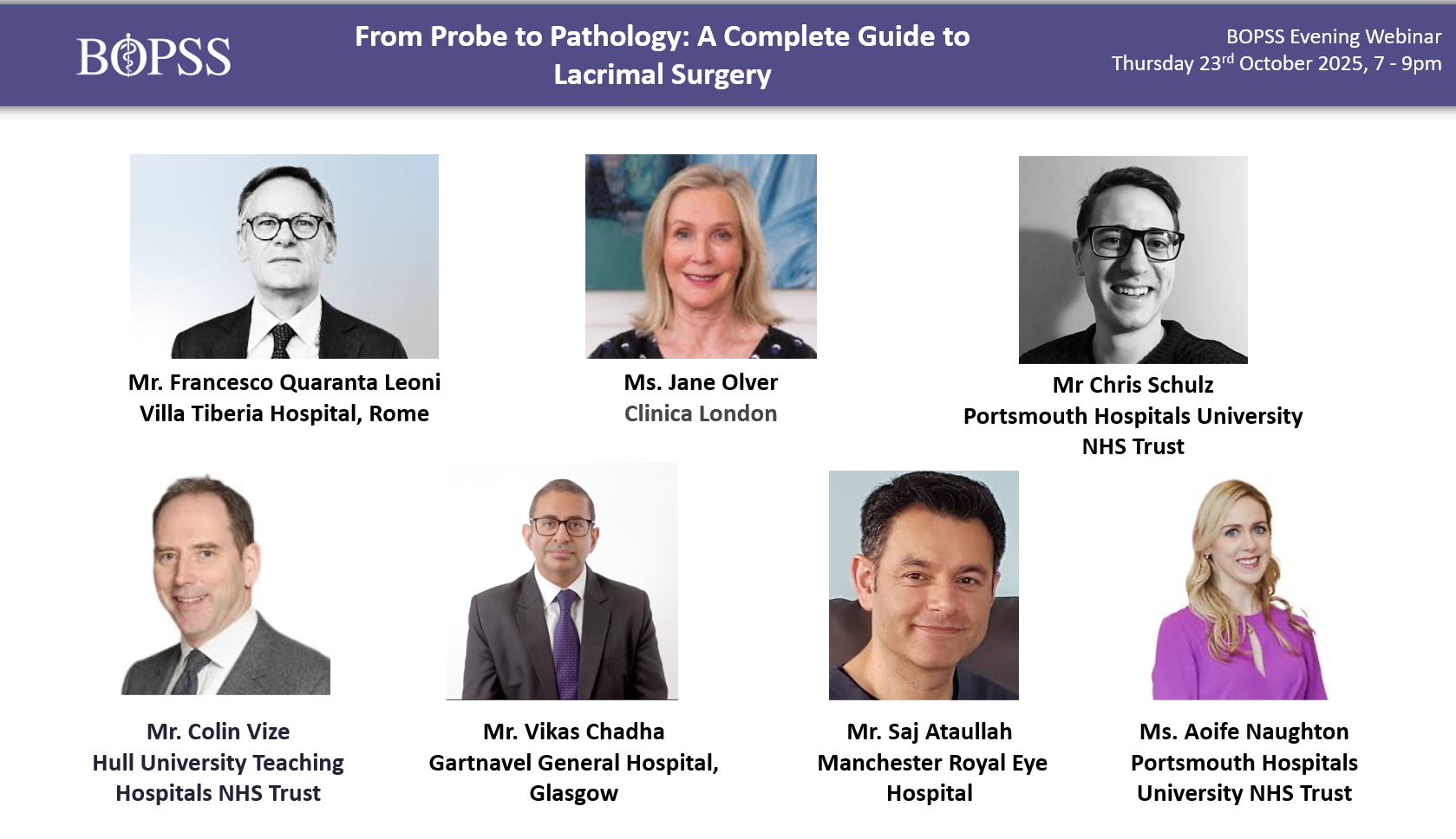
Chaired by Saj Ataullah and Aoife Naughton
7:00 PM: Welcome and Housekeeping, Aoife Naughton
7:05 PM: Anatomy and Investigations, Colin Vize
7:20 PM: External Dacryocystorhinostomy (DCR), Jane Olver
7:40 PM: Endonasal Dacryocystorhinostomy (DCR), Chris Schulz
8:00 PM: Lester Jones Tube Placement, Colin Vize
8:15 PM: Management of Post-Operative Tearing, Francesco Quaranta Leoni
8:35 PM: Lacrimal Sac Tumour Management Vikas Chadha
8:50 PM: Final Q&As
This webinar promises to be an invaluable learning opportunity for all oculoplastic surgeons interested in advancing their understanding and management of lacrimal concerns.
If you have registered for the webinar you will be able to view the recording for 1 month after the event, and all paid BOPSS members will be able to view the webinar at any time.
Webinar Recording
Summary
The BOPSS Evening Webinar focused on various aspects of adult lacrimal surgery, with presentations by leading lacrimal surgeons, covering anatomy, clinical examination, investigations, and differing surgical techniques. The meeting included discussions on different surgical approaches, including external and endoscopic DCR, as well as the management of post-operative complications and challenges. The panellists also addressed rare diagnostic cases involving lacrimal sac tumours and emphasized the importance of collaborative multidisciplinary approaches for complex cases.
Summary
The webinar was organised by Aoife Naughton and Katya Tambe
The webinar was chaired by Saj Ataullah and Aoife Naughton
Anatomy and Investigations, Colin Vize
Colin Vize from Hull provided a comprehensive overview of lacrimal anatomy, investigations, and clinical examination techniques, emphasizing the importance of proper punctal dilation and the role of valvular mechanisms in the lacrimal pump. He also discussed the use of DCGs and lacrimal scintigraphy, noting that while DCG can be useful, lacrimal scintigraphy doesn’t significantly enhance standard lacrimal surgery practice.
External Dacryocystorhinostomy (DCR), Jane Olver
Jane Olver lacrimal surgeon from Clinica London presented on external DCR surgery, highlighting its historical significance and current relevance despite the popularity of endoscopic endonasal DCR. She emphasized that external DCR remains an important technique and should not be a forgotten technique, particularly in settings where endonasal equipment is not available, or in the elderly where local anaesthetic is preferred. External DCR should be part of surgical training. Jane presented the different skin incisions and shared her experience with a hybrid approach that incorporates endoscopic monitoring during external DCR. She also discussed post-operative protocols, including the use of nasal douching and antibiotics, and addressed questions about scar minimization and the use of steroids and Otrivine after surgery.
Endonasal Dacryocystorhinostomy (DCR), Chris Schulz
Chris Schultz, a consultant oculoplastic surgeon from Portsmouth, discussed the benefits and techniques of endoscopic DCR surgery. He emphasized that while external DCR may be more suitable for some surgeons, learning endoscopic DCR can improve surgical skills and patient outcomes. Chris highlighted the importance of understanding nasal anatomy and performing adequate osteotomies and sac marsupialization to prevent surgical failures. He also recommended finding a mentor and collaborating closely with ENT surgeons to enhance surgical experience and success rates. Chris discussed his approach to endoscopic DCR, including the use of septoplasty in 25% of cases and postoperative management with absorbable stents and tranexamic acid.
Lester Jones Tube Placement, Colin Vize
Colin presented on Lester Jones tube techniques, emphasizing the importance of primary carunculectomy followed by delayed Lester Jones tube placement, allowing for the caruncular bed to heal for several weeks prior to placement of the Lester Jones tube. The discussion highlighted ongoing challenges with these procedures and the need for continued refinement of techniques and postoperative care. Colin discussed his approach to managing granulomas post-op after Lester Jones tube surgery and the use of longer tubes angled downwards approximately 40 degrees to the horizontal for improved drainage of tears and good stability. He also shared his preference for 5-0 Mersiline over Prolene for suturing of the tube at the medial canthus.
Management of Post-Operative Tearing, Francesco Quaranta Leoni
Francesco is an oculoplastic and lacrimal surgeon from Rome who presented on post-operative management of persistent tearing after DCR, outlining assessment methods and criteria for surgical success or failure. He highlighted the importance of re-examination and imaging in cases of persistent symptoms and discussed 6 categories of DCR failure. Francesco presented on the causes and management of failed lacrimal surgeries, highlighting surgical technique issues, excessive bleeding, and missed diagnoses as key failure factors. He discussed various surgical approaches for revision DCR, including endoscopic and external methods, and introduced the technique of orbital lobe lacrimal gland removal as a last resort for persistent epiphora. Saj inquired about Francesco’s experience with orbital lobe removal, which Francesco reported was limited to fewer than 10 cases with maximum follow-up 2.5 years.
Lacrimal Sac Tumour Management Vikas Chadha
Vikas Chadha, consultant ocular oncologist and oculoplastic surgeon from Glasgow, discussed the rare diagnostic challenge of managing Lacrimal sac tumours. He highlighted that malignant lesions are more common than benign, affecting the older age group, and often present with symptoms like epiphora, blood in tears, and a palpable medial canthal swelling. Vikas emphasized the importance of a high index of suspicion and early scanning, often using both CT and MRI for diagnosis. He also discussed biopsy approaches and surgical management, advocating for a collaborative multidisciplinary approach due to the complexity of these cases.
If you have any questions please contact aoife.naughton2@nhs.net


